- Shrikrupa Soc Rees, Khalapur, Panvel-II Raigad Raigarh MH 410206 IN
- gethonoraryphd@gmail.com

Phone Number
+91-8655502244
+91-7893528657
Email Address
gethonoraryphd@gmail.com
+91-8655502244
+91-7893528657
gethonoraryphd@gmail.com



 by PhD Duniya
You've spent years climbing the corporate ladder, and now you're wondering what comes after the MBA. For many senior professionals, the answer is a Doctor of Business Administration.
A DBA degree is a terminal, practice-focused doctorate. It trains experienced leaders to apply research to real business problems. That combination of credibility and strategic thinking opens doors to some of the best-paying roles in the United States.
This guide covers the top-paying careers for DBA graduates, what each role involves, realistic salary expectations, and how to choose the right path.
A Doctor of Business Administration is a doctoral program for experienced professionals who want to solve applied business problems through research. Most programs take three to five years, and many are offered part-time or online for working executives.
Feature | DBA | PhD in Business |
Focus | Applied research, real-world problems | Theoretical research, new academic theory |
Ideal candidate | Senior managers, executives, consultants | Aspiring full-time researchers and professors |
Typical outcome | Leadership, consulting, teaching | Tenure-track research careers |
Format | Often part-time or online | Usually full-time, on campus |
Both are respected doctorates. The DBA suits people who want to keep their industry careers and raise their earning power.

In most cases, yes, but not automatically. The doctorate adds credibility, strategic depth, and access to senior and advisory roles. Your pay still depends on your industry, experience, location, and the position you move into.
A note on salary figures: The ranges below are general estimates. Actual pay varies widely by company size, region, and industry. Check the latest data from the U.S. Bureau of Labor Statistics (BLS) and reputable salary sources before making decisions.
CEOs set the vision, strategy, and culture of an organization. A doctorate can strengthen your case for the top seat, especially in complex, data-driven, or regulated industries.
COOs run daily operations and turn strategy into results. The applied research skills from a DBA help with process optimization, supply chain decisions, and organizational design.
CFOs manage financial planning, risk, reporting, and investor relations. A DBA in finance or accounting adds analytical rigor and credibility with boards and investors.
Consulting firms and independent practices value the credibility of a doctorate. Many DBA graduates launch their own advisory businesses, which can produce high earnings.
CSOs guide long-term growth, mergers and acquisitions, and market positioning. The research training from a DBA program is a direct fit.
Organizations pay a premium for leaders who can turn data into decisions. Graduates who combine a DBA with quantitative or technology experience are especially competitive.
Large hospitals, foundations, and universities often hire doctoral-level leaders. Compensation is usually lower than in the private sector but can still be substantial at large institutions.
Professor pay varies by school, rank, and field. Finance, accounting, and analytics faculty at well-funded universities tend to earn the most. Many DBA holders teach part-time while continuing to earn from consulting or executive work.
With experience, some DBA graduates move into leadership roles such as department chair, program director, or dean. These roles combine academic and executive responsibilities.
Experienced executives with a doctorate are often invited to serve on boards or advisory councils. Compensation varies, but board seats can add significant income and influence.
Role | Typical Environment | Earning Potential |
CEO | Corporations, startups | Very high |
CFO | Corporations, finance firms | Very high |
COO | Corporations | High to very high |
Management Consultant | Firms, independent | High (varies) |
Chief Strategy Officer | Corporations | High |
Chief Data Officer | Tech, finance, healthcare | High |
Dean / Administrator | Universities | Moderate to high |
Business Professor | Universities | Moderate to high |
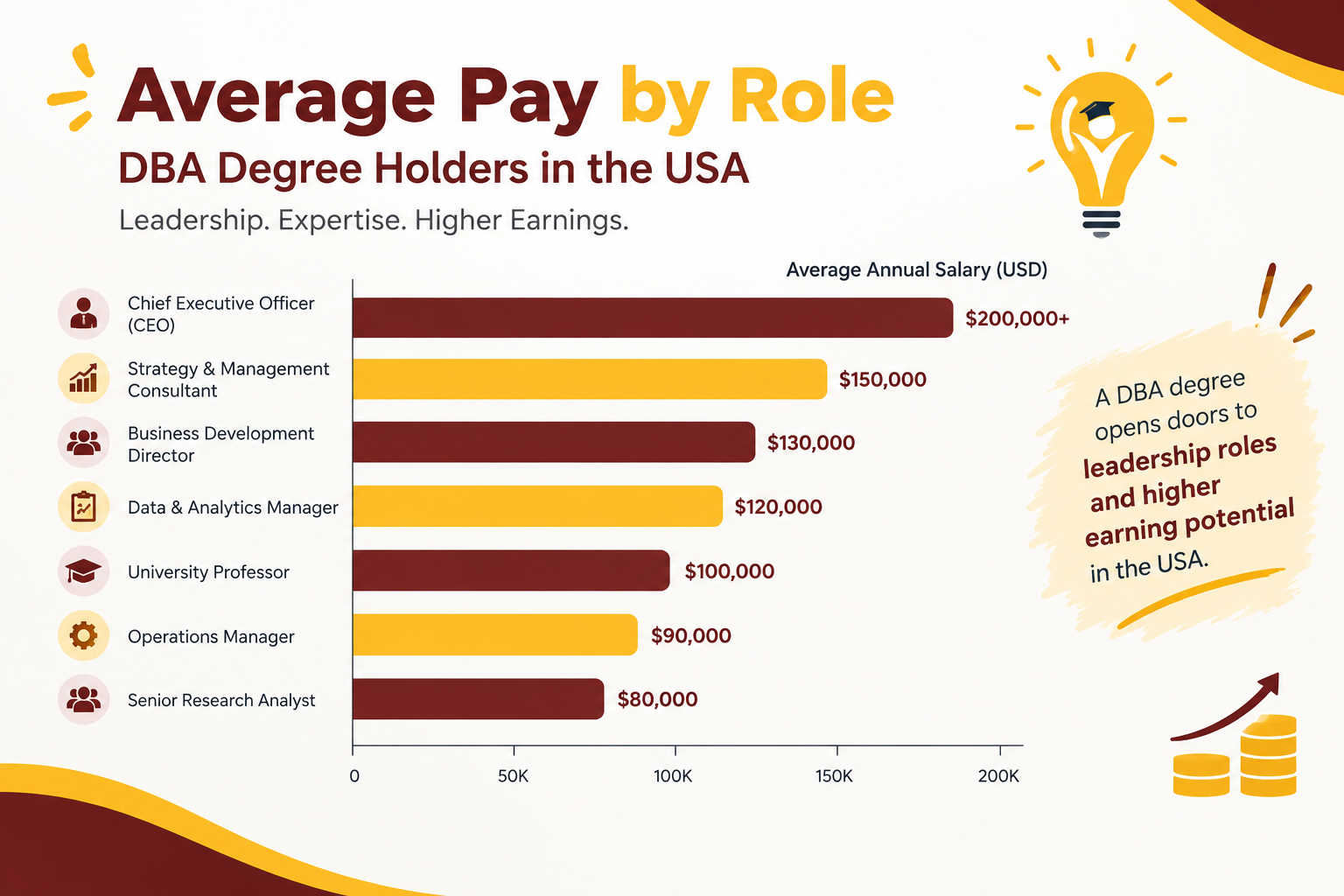
Your degree is one input among several:
A doctorate is a major investment of time and money. It tends to pay off most for people who:
If your only goal is a quick raise, an MBA or specialized certificate may offer faster returns. If you want authority, depth, and long-term career flexibility, a DBA degree can be a strong choice.
A DBA degree can open doors to some of the most rewarding careers in the USA, including executive leadership, consulting, analytics, and academic administration. For professionals exploring an online DBA in India, final earnings will depend on experience, industry, skills, and the strategic career choices you make along the way.
Start by defining your career goal, comparing accredited programs, and checking current salary data from trusted sources. If you're ready to explore doctoral options and planning resources, visit PhDDuniya to take your next step.
C-suite roles such as CEO, CFO, and COO typically offer the highest total compensation, especially at large organizations.
Yes. Many business schools hire DBA holders, particularly for teaching, clinical, and professional-practice positions. Tenure-track research roles often prefer a PhD.
They serve different purposes. An MBA is a broad master's degree, while a DBA is a doctorate for advanced and senior careers. The DBA often pays off later in a career.
Most programs take three to five years, depending on format and dissertation progress.
Yes. Many accredited U.S. universities offer online or hybrid DBA programs designed for working professionals.