- Shrikrupa Soc Rees, Khalapur, Panvel-II Raigad Raigarh MH 410206 IN
- gethonoraryphd@gmail.com

Phone Number
+91-8655502244
+91-7893528657
Email Address
gethonoraryphd@gmail.com
+91-8655502244
+91-7893528657
gethonoraryphd@gmail.com


 by PhD Duniya
If you have spent years in business and want a doctorate, the choice between a DBA, a PhD, and a DBM can be confusing. The names sound similar, but the programs are built for different careers. The question is even more common among professionals comparing a DBA course in India with options abroad.
In short: a DBA is usually the best fit for experienced professionals who want to solve real business problems. A PhD suits people who want a research or university career. A DBM is a less common title that is usually similar to a DBA, so check the curriculum rather than the name. This guide explains how each one works and how to choose.
A Doctor of Business Administration is an applied doctorate. It trains experienced managers and consultants to use research methods on practical business problems, such as why a company's retention is falling or how to enter a new market.
Most programs expect a master's degree, often an MBA, and several years of work experience. Many are part-time or executive format so students can keep working. The program usually ends with a thesis or dissertation that addresses a real organizational or industry problem.
A PhD in management is a research doctorate. Its main aim is to produce new theory and contribute original knowledge to academic literature. Students usually go deep into one area, such as marketing, finance, operations, or organizational behavior, and are trained to publish in peer-reviewed journals.
PhD programs are often full-time and take longer than a DBA. In India, they are governed by University Grants Commission (UGC) regulations, which cover admission, coursework, duration, and thesis evaluation. Check the current rules directly, as they are updated from time to time.

A Doctor of Business Management is the least standardized of the three. Some universities use it as another name for a DBA. Others use it for a management-focused doctorate with more emphasis on leadership, strategy, or organizational practice.
Because the name is not used consistently, the title alone tells you little. Look at the research methods training, the dissertation requirements, and the faculty. Also confirm how the degree is recognized in the country where you plan to use it.
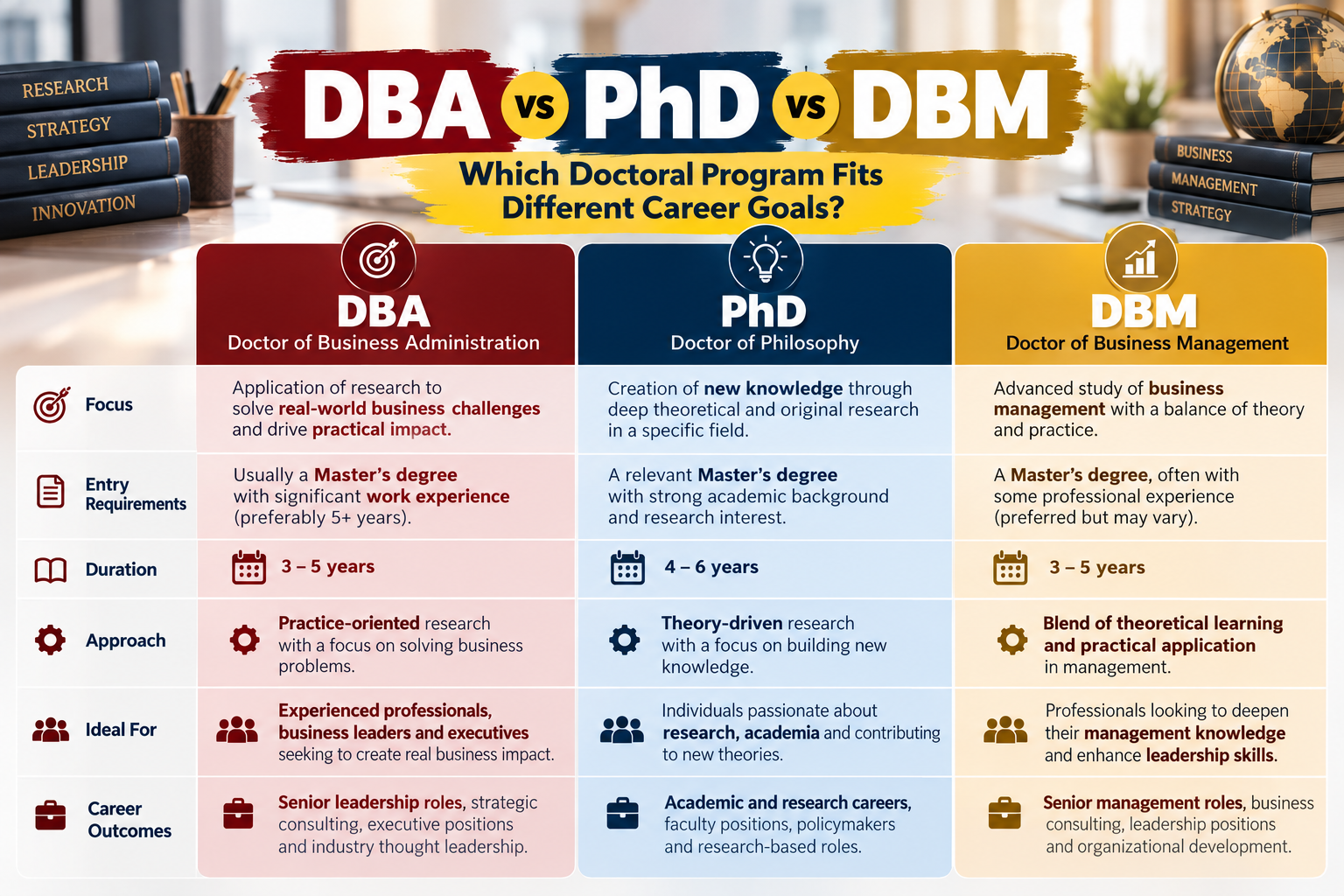
Factor | DBA | PhD | DBM |
Main focus | Applied research on business problems | Original theoretical research | Varies; often similar to a DBA |
Best for | Senior professionals, consultants, executives | Aspiring academics and researchers | Professionals, check the curriculum. |
Typical entry | Master's degree plus work experience | Master's degree, often with entrance tests and research proposals | Similar to a DBA |
Study mode | Often part-time or executive | Often full-time | Varies |
Typical output | Applied dissertation | Thesis aimed at journal publication | Applied or mixed |
Typical duration | Roughly three to four years | Often longer, and varies by university | Varies |
Entry requirements, duration, and format differ by university and country, so treat this table as a starting point.
A DBA is usually the stronger choice if your goal is senior leadership, consulting, or a board-level advisory role. The research is tied to your industry, and the part-time format lets you continue working. A DBA project can also double as a long-term study of a problem your company actually faces.
A PhD is generally the safer route to a full-time academic career. Many universities, especially research-focused ones, prefer or require a PhD for tenure-track roles. If publishing papers and supervising students appeals to you, this is the more direct path.
Some institutions do hire DBA holders as teaching faculty or practitioners-in-residence, but policies vary widely. Check the requirements of the specific institutions you have in mind.
Treat a DBM like a DBA until you learn otherwise. Ask the university for the module list, dissertation guidelines, and examples of past research. If the structure matches a DBA, you can compare it on the same terms.
A DBA course in India can come from an Indian institution, a foreign university delivering through a partner, or an online provider. These are not equal in recognition, so some checking is worthwhile.
Recognition and approval. Confirm that the institution and the degree are recognized by the relevant authority, such as UGC or the Association of Indian Universities (AIU) for equivalence questions. This matters if you plan to use the degree for teaching, government roles, or further study. Do not rely on a provider's marketing claims; verify with the regulator.
Eligibility. Most programs ask for a master's degree and professional experience. Some require a research proposal or an interview. Confirm the exact criteria in writing.
Format and time commitment. Check whether classes are online, on campus, or blended, and how much residential time is required. Doctoral work takes sustained effort, so be realistic about your schedule.
Research support. Ask about supervisor allocation, research methods training, and how often you will meet your supervisor. These affect your experience more than the brand name does.
Costs. Fees vary widely between providers and formats. Ask for the full cost, including thesis, examination, and residency fees, not just the headline tuition.
Career relevance. Ask what alumni do after graduating. A good program should be able to describe outcomes without exaggerated promises.
The first is choosing by title instead of structure. A DBA, DBM, and PhD can each be rigorous or weak, so the curriculum and supervision matter more than the label.
The second is skipping recognition checks. This is especially risky with programs from overseas institutions delivered in India, where recognition for specific uses can differ.
The third is underestimating the workload. A doctorate takes years of consistent effort, and many students stall at the dissertation stage.
The fourth is choosing a DBA when the real goal is a university research career or choosing a PhD when the real goal is applied leadership. Match the program to where you want to be in ten years.
A DBA, a PhD, and a DBM are all doctoral degrees, but they point toward different careers. A DBA suits experienced professionals who want to apply research in practice. A PhD suits those aiming for academic research and teaching. A DBM usually sits close to a DBA, but the name varies, so judge it by what the program teaches.
Before applying for any DBA course in India, verify recognition, understand the time commitment, and ask to see the research structure. Start from your career goal, then choose the program that supports it. For guidance on doctoral programs and career-focused options, visit PhD Duniya to take your next step.
No. A DBA focuses on applying research to practical business problems, while a PhD focuses on creating new theory for academic audiences. Both are doctoral degrees, and both require a substantial dissertation.
Sometimes, but it depends on the institution and its rules. Many universities prefer a PhD for tenure-track research roles, while some accept a DBA for teaching or practice-focused positions. Check the requirements of the institutions you are targeting.
A DBM, or Doctor of Business Management, is a doctorate in management offered by some universities. It is often similar to a DBA, but the name is not standardized, so compare the actual curriculum.
Typically, applicants hold a master's degree, often an MBA, and have several years of managerial or professional experience. Requirements differ by institution, so confirm them with the provider.