- Shrikrupa Soc Rees, Khalapur, Panvel-II Raigad Raigarh MH 410206 IN
- gethonoraryphd@gmail.com

Phone Number
+91-8655502244
+91-7893528657
Email Address
gethonoraryphd@gmail.com
+91-8655502244
+91-7893528657
gethonoraryphd@gmail.com



 by PhD Duniya
Earning a Doctor of Business Administration (DBA) is one of the most significant academic and professional achievements a business leader can pursue. Unlike a traditional Ph.D., which is largely research-focused, a Doctor of Business Administration blends advanced theory with real-world application, preparing graduates to solve complex organizational problems at the highest level.
If you're considering this path or you've already completed your doctorate, you're probably asking one important question: What career options open up after a Doctor of Business Administration? This article walks through the top career paths available to DBA graduates, the skills that make you stand out, and how to position yourself for long-term success in academia, industry, and consulting.

What Is a Doctor of Business Administration?
A doctor of business administration is a terminal degree designed for experienced professionals who want to deepen their strategic, analytical, and leadership capabilities. It typically combines coursework in advanced business theory with an applied research project or dissertation that addresses a real organizational challenge.
Because the degree is practice-oriented, graduates are equipped not just to analyze business problems but to lead organizations through them, making the DBA a strong launchpad for senior leadership, consulting, and academic careers.
Why Career Options Expand After a DBA
A doctor of business administration signals to employers that you possess the following:
This combination makes DBA holders attractive candidates for roles that require both operational know-how and thought leadership.
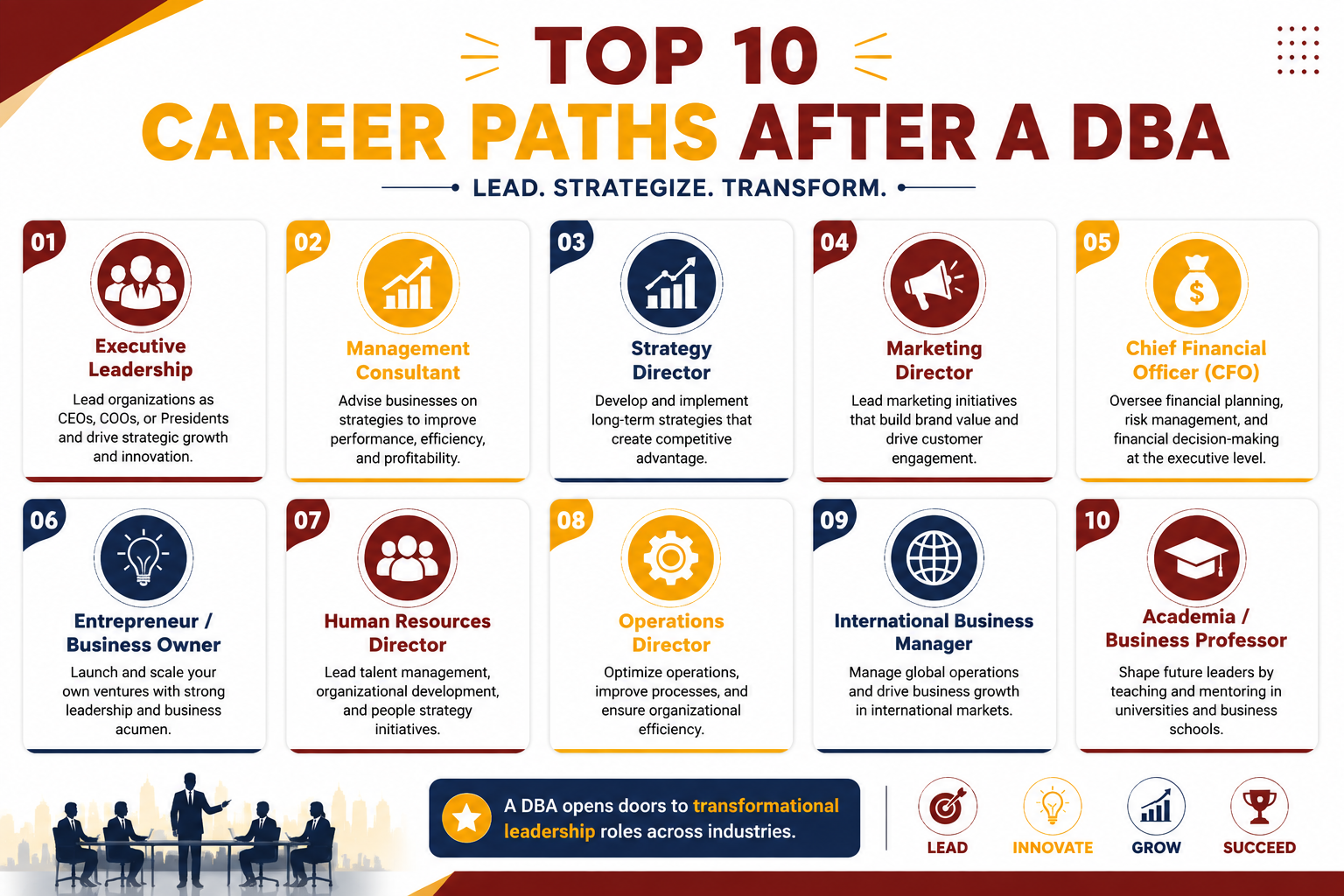
Top Career Options After a Doctor of Business Administration
Many DBA graduates use the degree to move into or solidify positions such as CEO, COO, CFO, or CMO. The doctoral-level training in strategy, finance, and organizational behavior gives executives a stronger analytical foundation for high-stakes decision-making.
Consulting firms value the DBA's blend of research rigor and applied business knowledge. Graduates often work with firms like McKinsey, Deloitte, or boutique strategy consultancies, advising organizations on growth strategy, operational efficiency, and digital transformation.
A doctor of business administration qualifies graduates to teach at the university level, particularly in professional and executive MBA programs. Many business schools value the DBA's practitioner perspective alongside traditional PhD-trained faculty.
Organizations increasingly hire DBA graduates to lead strategic planning departments, where they translate market research and internal data into long-term business strategy.
The research and leadership skills gained during a DBA program often give graduates the confidence and expertise to launch their own ventures, from consulting practices to scalable startups.
In industries like technology, pharmaceuticals, and manufacturing, DBA holders lead R&D departments, applying their research training to drive innovation and product development.
Government agencies and nonprofit organizations seek DBA graduates for executive director and policy leadership roles, valuing their ability to apply rigorous analysis to mission-driven work.
DBA graduates with a finance specialization often move into senior roles at banks, investment firms, and insurance companies, where advanced analytical skills are highly valued.
Specializing in change management and organizational behavior, DBA graduates help companies navigate mergers, restructuring, and culture transformation initiatives.
Many DBA graduates build platforms as authors and public speakers, publishing books and articles based on their doctoral research and sharing insights at industry conferences.

Comparison Table: Career Paths and Typical Focus Areas
Career Path | Primary Focus | Best For |
CEO / C-Suite Executive | Organizational leadership | Experienced managers seeking top roles |
Management Consultant | Strategy and operations advisory | Analytical problem-solvers |
University Professor | Teaching and applied research | Those passionate about education |
Corporate Strategy Director | Long-term business planning | Strategic thinkers |
Entrepreneur | Business creation and growth | Independent, risk-tolerant professionals |
R&D Director | Innovation and product development | Industry specialists |
Nonprofit Executive | Mission-driven leadership | Purpose-focused professionals |
Financial Services Executive | Financial strategy and risk | Finance-focused graduates |
Organizational Development Consultant | Change management | People-focused strategists |
Author / Thought Leader | Knowledge sharing | Graduates with strong research output |
Skills That Make DBA Graduates Stand Out
How to Choose the Right Career Path After Your DBA
Resources such as PhDDuniya can also be useful for researching doctoral programs and staying updated on career trends for DBA and PhD holders.
Conclusion
A doctor of business administration opens doors to some of the most influential and rewarding roles in business, from the C-suite to the classroom. Whether you're drawn to executive leadership, consulting, academia, or entrepreneurship, this doctoral degree equips you with the strategic thinking and credibility needed to lead at the highest level.
If you're weighing your next move after completing a doctorate of business administration, take time to reflect on your strengths, interests, and long-term goals. The right path is the one that aligns your expertise with the impact you want to make.
Frequently Asked Questions
1. What can you do with a doctor of business administration?
Graduates can pursue executive leadership roles, consulting, teaching, entrepreneurship, and research-driven positions across industries.
2. Is a DBA better than an MBA for career advancement?
A DBA is a terminal degree focused on advanced research and strategic expertise, making it better suited for executive, consulting, and academic roles, while an MBA is often more general and mid-career focused.
3. Can I become a professor with a DBA?
Yes. Many business schools hire DBA graduates to teach, particularly in professional and executive programs.
4. How long does it take to complete a doctorate of business administration?
Most DBA programs take three to five years to complete, depending on the institution and whether it's pursued full-time or part-time.
5. Is a DBA worth it for entrepreneurs?
Yes, the research and strategic skills gained during a DBA can strengthen an entrepreneur's ability to make informed, evidence-based business decisions.